













.png?width=397&height=365&name=CPDmember%20(1).png)
Management, Maintenance & Replacement of Cold Water Storage Tanks
Cold water storage tanks play an important role in many large buildings and across estates, helping maintain a reliable water supply across properties with significant or fluctuating demand.
They are commonly found across hospitals, residential blocks, educational facilities, hotels and large commercial buildings. However, their size, location and connection to extensive water distribution systems mean they also need to be carefully managed as part of an effective water hygiene programme.
Poorly maintained tanks can contribute to conditions that encourage bacterial growth, including Legionella, making regular inspection, monitoring and maintenance essential.
Why Cold Water Storage Tanks Require Careful Management
The objective of a cold water storage tank is relatively simple: store sufficient wholesome water and supply it throughout the building when required.
In a large building, however, the wider system can become considerably more complicated. A single property may contain multiple tanks, extensive distribution pipework, numerous outlets and areas with significantly different patterns of water usage.
If water is stored for too long, temperatures increase or contamination enters the tank, water quality can deteriorate. Problems within a storage tank can subsequently affect the wider system it supplies.
This makes understanding the condition, operation and usage of each tank an important part of managing water hygiene risk.
What Temperature Should a Cold Water Storage Tank Be?
Cold water should generally be stored and distributed at below 20°C to help control the risk of Legionella growth.
Temperature is one of the key considerations when controlling Legionella risk. Where stored water becomes warmer, particularly when combined with stagnation or low turnover, conditions can become increasingly favourable for bacterial growth.
Large buildings can present particular challenges. Tanks may be situated in warm plant rooms or roof spaces, located close to heat-producing equipment or affected by inadequate insulation. The size of the tank itself can also become a problem if storage capacity significantly exceeds actual building demand.
Regular temperature monitoring can help identify these issues and allow corrective action to be taken before they become an ongoing compliance concern.
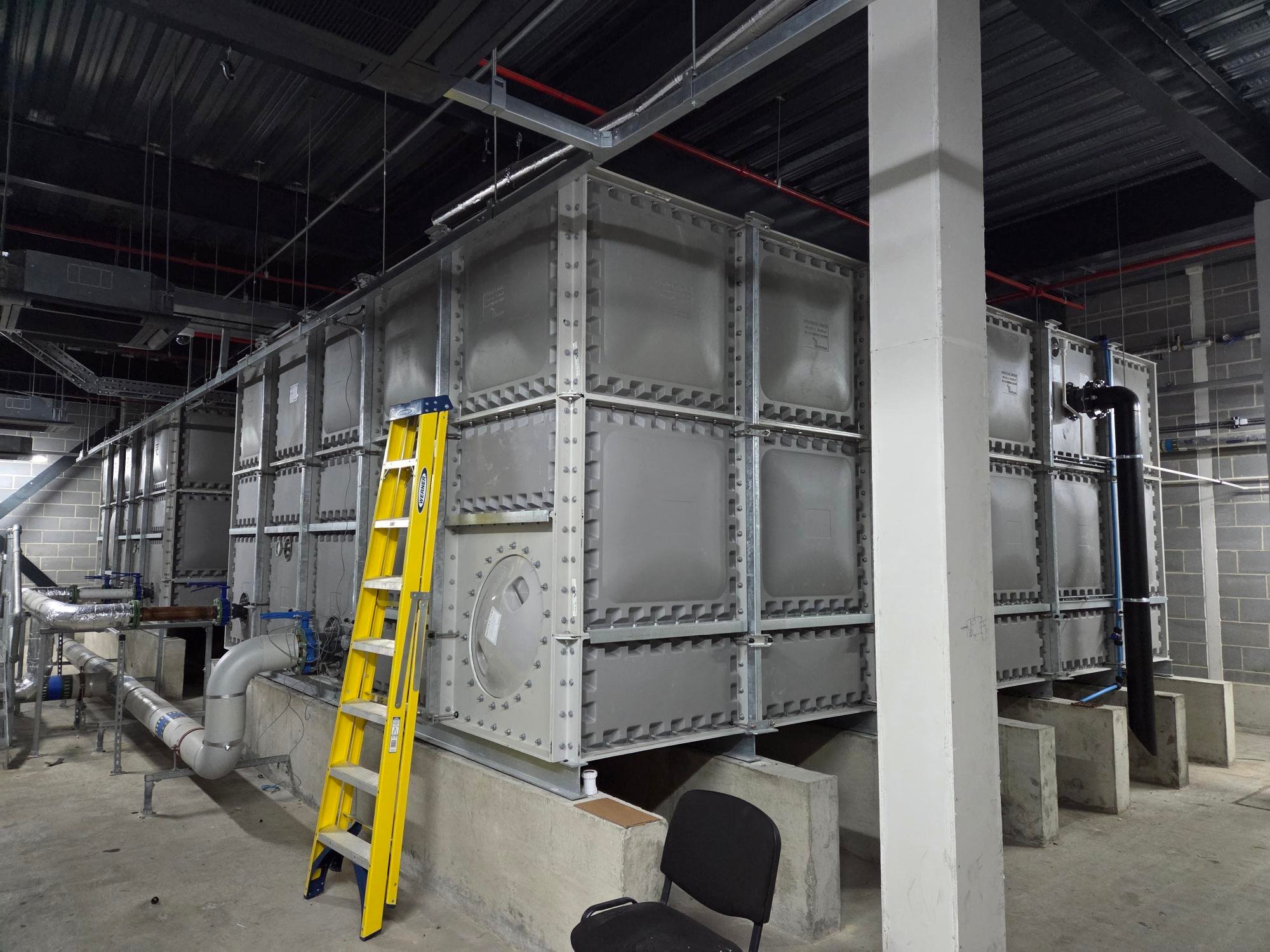
Is Your Tank Storing More Water Than You Actually Need?
Oversized cold water storage tanks are an issue that can sometimes be overlooked.
Buildings and their usage change over time. A tank originally designed to serve a particular occupancy level or operational requirement may no longer reflect how the property is being used today.
If capacity is considerably greater than demand, water turnover can reduce and increase the potential for stagnation.
For organisations managing large estates, reviewing tank capacity alongside current building demand can therefore be just as important as inspecting the physical condition of the tank.
When Should a Cold Water Storage Tank Be Replaced?
A cold water storage tank may need replacing when its condition, design, capacity or configuration can no longer support effective water hygiene management.
Routine inspection, cleaning and maintenance can help keep cold water storage tanks in good condition, but there may come a point where remedial work is no longer the most appropriate solution.
Replacement may need to be considered where a tank has significantly deteriorated, is showing signs of corrosion or leakage, is difficult to clean effectively or its existing design makes appropriate water hygiene management difficult. Changes in building occupancy or demand can also mean an existing tank is no longer appropriately sized for the system it serves.
For large and operational buildings, tank replacement requires careful planning. The new system needs to reflect current and anticipated demand while maintaining water supply and minimising disruption to building users. Access, installation constraints, tank configuration, insulation and integration with the existing distribution system all need to be considered.
Replacing an ageing or unsuitable tank also provides an opportunity to address historic issues within the system. Rather than replacing like-for-like automatically, organisations can review storage capacity, improve water turnover and introduce a solution better suited to the way the building operates today.
What Should Be Checked During a Cold Water Storage Tank Inspection?
Cold water storage tanks should be included within an appropriate water hygiene inspection and monitoring regime.
Inspections should consider the overall condition and cleanliness of the tank, whether lids and screens are adequately fitted, signs of corrosion or deterioration, insulation, water temperature and evidence of sediment, debris or contamination.
The configuration of the system should also be considered. Poorly positioned inlet and outlet connections, for example, can create areas where water circulation is limited.
Importantly, inspections shouldn't simply identify a problem. Findings should feed into a clear process for prioritising, completing and recording any necessary remedial actions.
How Do You Manage Cold Water Storage Tanks Across a Large Estate?
For organisations responsible for multiple large buildings, managing individual tanks is only part of the challenge.
Housing providers, NHS organisations, universities, local authorities and facilities management teams may be responsible for hundreds of water hygiene assets spread across multiple sites.
Each building can have different risk assessments, monitoring frequencies, remedial requirements and servicing dates. Without effective oversight, it can become difficult to establish where risks exist, whether actions have been completed and which assets require attention next.
This is why water compliance needs to be viewed as an ongoing management programme rather than a series of isolated inspections.
From Assessment to Ongoing Compliance
An effective water hygiene programme should provide a clear understanding of the condition of the system, identify potential risks and ensure appropriate control measures remain effective.
At Ventro Environmental, we support organisations with the management of water compliance across individual buildings and complex estates.
Our approach covers Legionella risk assessments, water monitoring, cold water storage tank inspection, maintenance and replacement, treatment plant and equipment, remedial works and planned preventative maintenance.
By bringing assessment, remedial action and ongoing monitoring together, we help clients maintain greater visibility of water hygiene risks across their buildings and demonstrate that identified actions are being appropriately managed.
Our Assess. Address. Compliant. Maintain. approach provides a clear route to ongoing environmental compliance. We assess your buildings to identify risks, address any issues through appropriate remedial works, ensure your systems are compliant, and provide ongoing monitoring and maintenance to keep them there.
| Assess | Address | Compliant | Maintain |
Ventro Voice
Cold water storage tanks can easily become an overlooked part of a building’s infrastructure, particularly across large and complex estates. But simply having a programme of inspections isn’t enough. Building usage changes, water demand changes and systems age, meaning a tank that was suitable when installed may no longer be right for the building today.
We believe good water compliance means looking at the bigger picture. That means understanding how water moves through the building, identifying where risks are developing and taking action – whether that’s improved monitoring, remedial works, maintenance or complete tank replacement.
Need support with cold water storage tanks across your estate?
Ventro Environmental can support with tank inspections, monitoring, remedial works, maintenance and replacement as part of a wider water hygiene compliance programme.