















Following our recent Building Compliance Round Up 2026 webinar, we've gathered answers to the questions submitted by attendees during the live session. The webinar explored key compliance challenges, emerging risks, and regulatory developments affecting the built environment.
Our expert panel included Robert Thilthorpe from the Fire Industry Association (FIA), who discussed plug-in solar panels, battery storage, and associated fire safety considerations; Denley Nunn of Cygnus Systems, who provided insight into the Interim Measures Alarm Fund (IMAF) and interim fire alarm solutions; and Steven Wilson, Technical & Compliance Director at Ventro, who delivered a roundup of key regulatory updates, including the Building Safety Levy, Awaab's Law, BS 7671 Amendment 4, and changes to Approved Document B.
Below, we answer some of the most frequently asked questions from the session and provide practical guidance on the topics discussed.
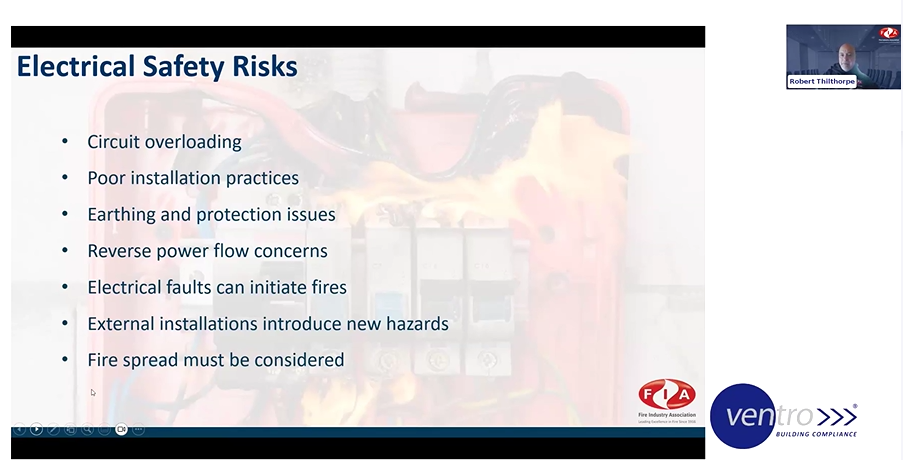
Q1: For a rental property, could tenants ask their landlord for permission? Alternatively, if the back garden is large enough and has no trees, could they be placed there to reduce the risk if they catch fire?
Yes, tenants can request permission from their landlord, and we would recommend this being best practice. Any necessary landlord, freeholder or planning consent should be obtained before installation. A garden may be a suitable alternative, but the absence of trees is not, by itself, evidence that the installation is safe. Our recommendation would be to check the approved mounting method, separation from combustible materials, cable route, weather exposure and the manufacturer’s instructions before agreeing a location. Only a compliant product should be used; this does not cover plug-in batteries. Worth noting that you might move the risk to your neighbours, depending on the garden specifically!Q2: How can the problem of festooning cables be addressed?
A competent contractor should assess the complete cable route and its supports, not just the cables themselves, against BS 7671 Regulation 521.10.202. If the question instead concerns loose solar-panel leads, we would always recommend a planned, securely supported route that avoids trip hazards and damage, with the connection arrangement checked against the product instructions.
Q3: What about HMOs, where each room is classed as a separate household?
Q4: For HRBs, do BSC reports need to be updated each time a resident has these installed, due to the impact on the fire load? Is planning permission required if a resident clips them over the balcony balustrade?
Q5: Robert, does the FIA offer training for installers with no previous experience?
Q6: Can an alarm system can replace a waking watch?
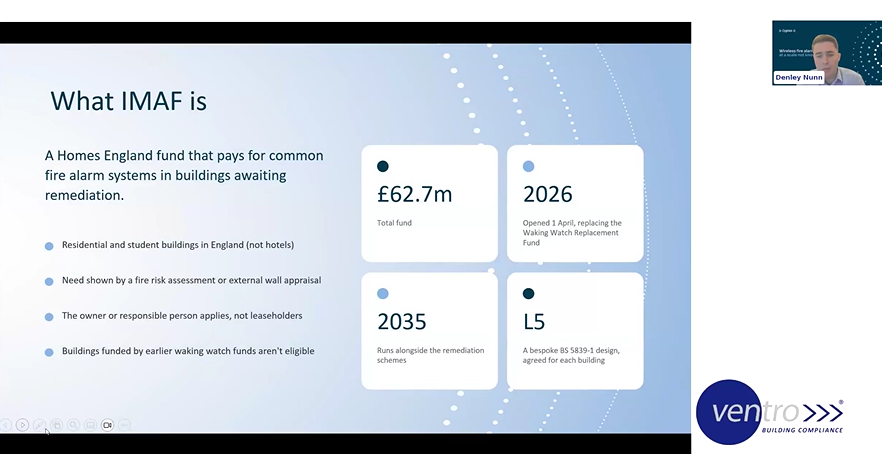
Q7: Would this retrospectively cover alarms installed to remove a waking watch? In this case, the alarms were installed in May, and the fire risk assessor and fire service signed off the removal of the waking watch in July.
Q8: Can a temporary L5 system be installed in an HRB without BSR approval, with a GW application submitted retrospectively? Given the known delays with BSR applications, could this be a fair and cost-effective approach when time is a priority?
No. You need BSR approval before work starts, and there’s no retrospective sign-off route for HRBs. The emergency repairs exemption covers repairs, not new systems.Q9: Who should carry out the survey if my organisation plans to install IMAF in some of our buildings?
Ventro are approved IMAF installers and our sister company Firntec are able to carry out all relevant surveys required for your application.
Q10: Has the performance of wireless systems in concrete buildings improved?
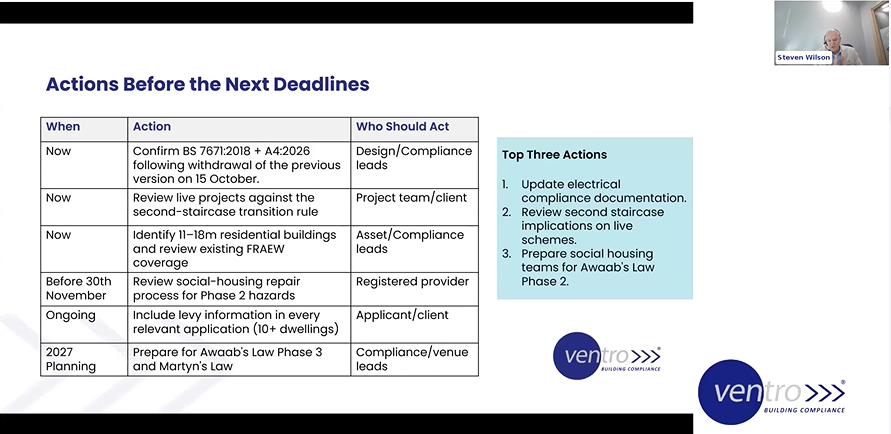
Q11: Steven, I understand that the levy applies to new buildings. For student accommodation that meets the criteria, does it apply only to new buildings, or to existing buildings as well?
Q12: For legacy PoE installations designed and installed before BS 7671 A4, what is expected in practice? Are organisations expected to assess these systems retrospectively against the new requirements? If so, what should the review cover, and what would trigger remedial action?
_____________
Thank you to everyone who joined our Building Compliance Round Up 2026 webinar, and a special thank you to our expert speakers, Robert Thilthorpe, Denley Nunn, and Steven Wilson, for sharing their knowledge and insights on some of the most important developments in building safety and compliance.
We hope you found the session valuable and the Q&A responses helpful. If you would like to stay informed about upcoming webinars, roundtables, and industry events hosted by Ventro, be sure to register your interest via our Future Events Interest Form.