













.png?width=397&height=365&name=CPDmember%20(1).png)
During our recent Building Legislation Safety Updates 2026 webinar, Josh Paulin, Operational Policy Advisor for the Building Safety Regulator (BSR), addressed audience questions on key BSR topics including Gateway 2 requirements, emergency works, and the BSR’s transition to becoming a standalone body.
Due to time constraints, we weren’t able to address every question during the live session. However, Josh has since reviewed all submitted questions and shared his expert responses below. If you’d like your own questions answered directly by industry specialists, be sure to register for updates on our upcoming webinars and join the conversation next time.
 Josh Paulin, Operational Policy Advisor
Josh Paulin has worked in operational policy and operational delivery for a number of years. Having originally trained as a scientist, he has worked within the NHS, in public policy for the New Zealand Government, before joining the Building Safety Regulator (BSR) as an Operational Policy Advisor in 2023.
Within the BSR he has worked on resident engagement policy for the in-occupation team, focusing on helping the industry understand the new resident engagement duties introduced by the Building Safety Act. Now as a member of the building control team, he helps BSR’s operational teams with interpretation of the legislation and regulations and regularly engages with industry to help inform about expectations within the new regulator.
Q1: What is best practice in consulting the BSR on changes whether major or notifiable following GW2 Submission. Is it best to wait until contacted?
BSR must be contacted for all major and notifiable changes made during construction. Major change applications are very similar to a Gateway 2 application, where an approval is required before any work articulated in the major change application can legally take place. Work can take place immediately on a notifiable change, but please be aware that BSR does monitor notifications, and will contact you if we think a change is in fact a major change requiring an application. The responsibility of deciding whether a change is major or notifiable sits with the Principal Contractor and Principal designer, as set out in Part 2A of The Building Regulations 2010.Q2: Can we also recognise inconsistencies in BSR "views". We have disparate views (one rejected and one approved) for two identical buildings?
BSR is very aware of variability in determinations and is working hard to try and improve consistency. Please bear in mind that BSR reaches its determination outcomes using MDTs, where differences in professional opinion can and will occur.
Q3: If BSR are now a separate entity, does this mean they are no longer part of the HSE but still report to them?
Q4: What about when work to an existing HRB is part of a fire engineered solution, rather than achieving the standards. How is this handled. Is it the RBI and Fire Engineer that advise the Reg Lead that the solution is considered appropriate as supplied by a suitably competent Fire Engineer.
Q5: Noting that each application is standalone - but how do we address when we are making the first in a series of applications or an application on a building with MOR etc
Q6: Josh, thank you for just confirming that the replacement of a fire door requires a gateway 2 app. Its seems though the application requirement reduced due to the simplicity of the task. Why is there no stronger push from everyone involved to include this under the competent person scheme. Social housing frequently needs replacement doors due to ASB and emergency services.
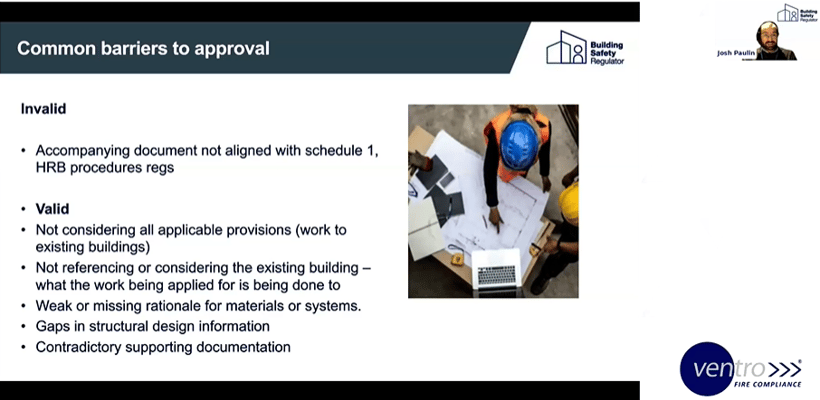
Q7: Would it be possible to get some more information the criteria for determining emergency repairs and provide some clarity on where the line is drawn, when risk assessment can be very subjective?
Q8: Is it possible to get some examples on Recordable, Notifiable and major changes?
Q9: Is it acceptable to include a contingency, for example in opening up a wall and finding construction is not as expected, but you could foresee this possibility?
Q10: Question for Josh: is an AI tool used to assess GW2 applications?
Q11: Who should manage the change control, contractor or PD?
Q12: The BSR and the BSA 2022 currently applies to HRBs and residential (situation dependent) – do you foresee that this will be expanded in the future and rolled out to apply to commercial properties and other building types as standard practice?
The Ministry of Housing, Communities and Local Government own the Building Regulations, including the HRB specific regulations. Any change to the scope or application of these regulations is dealt with by MHCLG and not BSR.Q13: You touched on this - There’s currently a knowledge delay in the industry regarding the full breadth of BSA 2022 and how this impacts design liabilities and ensuring safety is forefront during RIBA Stages 5-7 - I have experienced situations where it has been questioned whether the BSA 2022 applies at all to construction projects that are not HRBs – many are unaware of PAS 8671 and BS 8670 – do you think that this needs to be amplified to the industry and reinforced?
The Building Safety Act 2022 introduced a vast array of changes to The Building Regulations and The Building Act 1984. Some of these changes are specific to HRBs, but many changes impact on the whole built environment. Efforts are ongoing to publicise and raise awareness of changes to duties and regulations that were brought in by the BSA 2022.Q14: How do you envisage the golden thread evidence requirements will be incorporated into contracts under schedule amendments and how this will impact risk allocation and cost for projects, given that the dutyholder cannot legally delegate their responsibilities away to third parties?
Contractual arrangements and cost implications for projects is outside of the scope of BSR as a Building Control Authority.Q15: Can you clarify whether the current statutory and operational timelines for gateway determinations, building assessment certificates, and other key regulatory processes are expected to remain as they are? Additionally, is the BSR actively working on strategies to reduce these timelines, and if so, what improvements or efficiencies can duty holders expect in the near future?
BSR is actively working to improve determination timeframes to bring them in line with statutory timeframes as defined in law. Over the past year there has been a substantial overhaul to operational processes and organisation to improve determination times for building control applications. Data concerning building control approval applications to date can be foundhere (Building Safety Regulator building control approval application data - GOV.UK)
Q16: Why do the BSR insist on an answer regarding previous misconduct when there is no previous misconduct?
It is a legal requirement for any person who is considering using any other person to carry out work to a higher-risk building to ask whether a serious sanction has occurred, as described in Regulation 11E(2)(b) of The Building Regulations 2010, and required in the Competence Declaration of an application, as defined in Schedule 1 paragraph 1 of The Building (Higher-Risk Buildings Procedures) (England) Regulations 2023.Q17: I've heard rumours that the BSR are reconsidering whether hospitals should be categorised as a HRB and may be excluded in the future. Is this the case?
The Ministry of Housing, Communities and Local Government own the Building Regulations, including the HRB specific regulations. Any change to the scope or application of these regulations is dealt with by MHCLG and not BSR.Q18: When a large organisation uses their own Estates teams to carry out building work, as defined by Section 3 (meaning of Building Work) of BR 2010, and the organisation does not appoint a BRPD/BRPC, would that organisation take automatically the responsibilities of a BRPD/BRPC?
A client must make suitable arrangements for planning, managing and monitoring a project as to ensure compliance all relevant requirements. This includes the appointment of a PC and PD (Regulation 11D(1) of The Buildings Regulations 2010). If a client fails to make these appointments, they themselves must fulfil these legal duties (Regulation 11D(5) of The Buildings Regulations 2010).Q19: During the application process there is only the choice of uploading one document for a question. it means combining several documents to get the requirements over to the BSR, creating long documents to be assessed, where detail could be lost.
BSR welcomes feedback on portal design for making a Building Control Application and is continually striving to improve all processes.Q20: Does fire door reinstallation require BSR approval, as with replacement? When individual leaseholders are responsible for arranging and paying for works to their flat entrance doors, who submits a BSR application? How is the PAP involved with the BSR Gateway regime?
Any work to a higher-risk building that meets the definition of building work, as per Regulation 3 of The Building Regulations 2010, requires a building control approval application to be made to BSR. The client and the person carrying out the work bears ultimate responsibility for ensuring that they do not contravene any of the Building Regulations, including the requirement to have a building control application approved before work can take place. There is a requirement for certain information to be passed onto the AP and PAP, including any partial completion or completion certificates received for work carried out to a higher-risk building.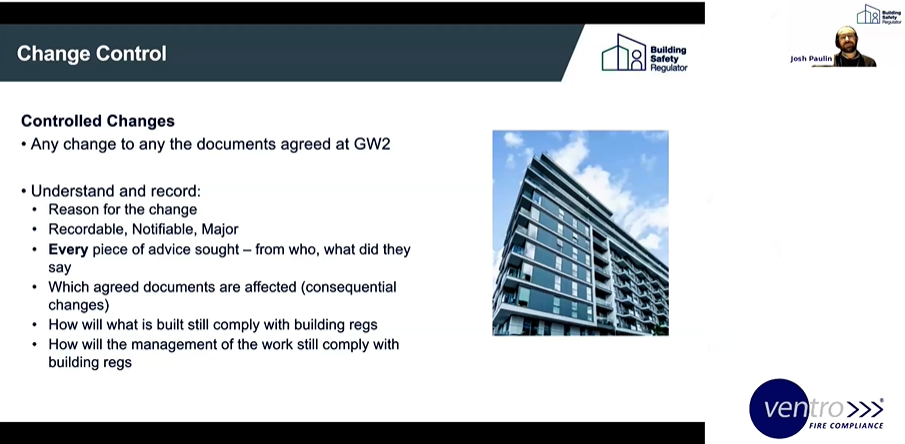
Q21: Hi - I know the answer to this - but for the benefit of others can you confirm the following - For product selection we refer to the CPR where applicable (Which is a law) - we still get clients not wanting to comply and instead refer to approved documents (ADB in particular) - We confirm that the law takes precedence and approved documents & need to catch up with the law and the golden thread is to comply with the CPR not the approved documents?
BSR regulates to the Building Regulations and the law, in particular the requirements articulated in Schedule 1 of The Building Regulations 2010. Standards and Approved Documents are ways that applicants can demonstrate that their design will meet those requirements, but the law and the requirements as set out in the Building Regulations take precedence.Q22: Please, please, please, can the BSR create a video showing the GW2 application process to ensure people, new applicants are aware of the process. Showing exactly how it presents itself on the portal.
A video showing how to navigate the portal can be found in this online webinar (Building control applications demystified for developers of HRBs webinar (July 2025)). From 6:27 shows the portal process.Q23: Whilst this information is helpful, it appears to be more focused on new-build developments. It would be beneficial to have a separate webinar specifically addressing existing, older buildings and how RPs/APs can practically manage the Building Safety Case, Gateway Applications for alterations and achieve compliance with the regulations?
The BSR campaign page contains many resources that you may find useful (Resources - Making Buildings Safer), and we are always looking at ways to improve our guidance, including by participating in webinars.Q24: I need to change/remediate communal fire doors in a HRB, do I need to submit a Gateway 2 before proceeding?
Work to fire doors, including their replacement, often constitutes building work, as defined in Regulation 3 of The Building Regulations 2010, and therefore requires a building control approval application to be made and approved before any work can take place. BSR recommends seeking expert independent advice if guidance is required on whether an application is required and how to make this application.Q25: Is there any scope for future changes within the BSR whereby the data requests for post-occupation will allow more than 7 days to return information? This is a consistent time sink for us.
The Ministry of Housing, Communities and Local Government own the Building Regulations, including the HRB specific regulations. Any change to the scope or application of these regulations is dealt with by MHCLG and not BSR.Q26: Does the replacement of an internal "FD20" door inside a flat require notification to the BSR?
Any building work to a higher-risk building as defined in Regulation 3 of The Building Regulations 2010 requires a building control approval application to be made and approved to BSR. The replacement of communal fire doors meets the definition of Building Work and therefore requires an application to BSR. Whether the replacement of an internal FD20 door within a flat meets this definition, will depend on many factors, and we recommend seeking expert independent advice if required to make this decision.Q27: To confirm, are you saying that you need a gateway 2 application to replace a fire door? That seems very disproportionate.
Yes, BSR considers the replacement of a fire door to be building work and therefore requires a GW2 application to be made and approved before any work can legally take place.Q28: Can any works which relate to fire safety be undertaken under any Competent Person Schemes or be considered exempt?
Work that is solely carried out under a Competent Person Scheme, or that meets the definition of Exempt Work, does not have to make a building control approval application to BSR before work can start (Regulation 11(2) of The Building (Higher-Risk Buildings Procedures) (England) Regulations 2023). Exempt work is defined in Schedule 2 of these regulations, and work covered by Competent Person Schemes can be found in Schedule 3 of The Building Regulations 2010. Please ensure that any CPS work is covered by the scheme provider for work to HRBs.Q29: Josh would installing/re-instating fire compartmentation to the original as built fire strategy count as relevant works under the BSR?
Yes, BSR would count any work to remediate internal fire compartmentation to meet the definition of Building Work and therefore require an application to be made to BSR and approved before any work could take place.Q30: Just for clarity is the process of replacing fire doors in HRB considered to be building work and would need to go through Gateway 2/3 process?
Yes, BSR considers the replacement of a fire door to be building work and therefore requires a GW2 application to be made and approved before any work can legally take place.Q31: How long does a Gateway 2 application take to be approved? I understand this can vary.
Determination times vary, but data on current determination times can be found hereQ32: Is the BSR recruiting?
Any BSR recruitment can be found on the Civil Service jobs site.Q33: How long is it taking for the building safety certificate process to be completed, we have had an application in since October 2025 and have still heard nothing?
Unfortunately, I only work on Building Control within BSR, and I am unaware of data on BAC application data.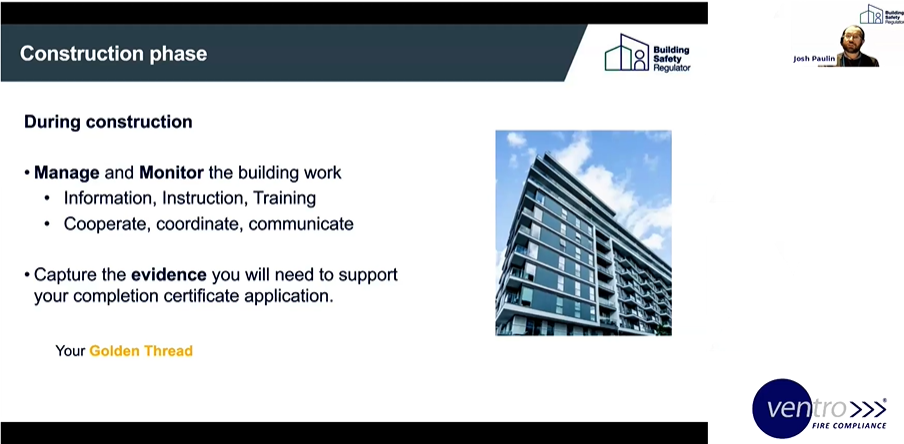
Q34: As an RBI working on a number of BSR projects, does the BSR have any plans to roll out any guidance/training to assist with consistency of approach?
BSR is developing internal guidance for operational teams, including MDT members, to aid consistency within BSR determinations.Q35: Josh's responses show things are moving in the right direction, but there are simple issues like where the PD and PC are the same the client has submitted a single competency letter on as number of GW2s and these have been in approved applications but recently we had one where there was an RFI asking for the PD and PC competency being 2 separate client letters.
BSR is very aware of variability in determinations, and is working hard to try and improve consistency.Q36: Does an Enforcement notice count as emergency repair?
Whether work would be acceptable as an emergency repair using Regulation 10 of The Building (Higher-Risk Buildings Procedures) (England) Regulations 2023), requires the risk to health, safety and welfare of persons in or around the building to be assessed against the practicability of making a GW2 application before starting works. An enforcement notice does not automatically mean work can be classed as an emergency repair.Q37: In regard to emergency works. What is the stance on compartmentation remediation works? There are many debates in industry as to whether this is emergency works, my view would be that there is not a lot that can be done to mitigate the risk of smoke and flame spreading other than rectify the breach.
Regulation 10 of The Building (Higher-Risk Buildings Procedures) (England) Regulations 2023) covers carrying out emergency repairs and not works. For this regulation to be utilised, a repair and not planned work must be taking place. Internal remediation works is often most appropriately dealt with via a GW2 application rather than an emergency repairs route. Please bear in mind that any emergency repairs that take place still need to go through the regularisation process, and providing sufficient evidence to receive a regularisation certificate can often be more difficulty that going through the GW2 process._____________
We’d like to extend our sincere thanks to Josh Paulin for his expertise and insight on the webinar and for answering the many questions our audience had for him and the BSR. Huge thanks to all of our speakers on the day for providing their expert knowledge and answering all of your questions.
Be sure to sign up for updates on our upcoming webinars here sign up, and if you have any questions about the topics covered in this Q&A, feel free to reach out below. One of our fire safety consultants will be happy to assist you.