














.png?noresize&width=397&height=365&name=CPDmember%20(1).png)
The Building Safety (Wales) Act represents one of the most significant changes to building safety legislation in Wales for a generation. Alongside the new higher-risk building procedures coming into force from 1 July 2026, the legislation introduces new responsibilities for dutyholders, enhanced accountability measures, stronger resident engagement requirements and a broader approach to building safety than has been seen elsewhere in the UK.
Following our recent Building Safety (Wales) webinar, we received a large number of questions from attendees on how the new requirements will work in practice. In this article, we answer the questions raised during the session, providing practical guidance to help organisations understand their responsibilities, prepare for the upcoming changes and take a proactive approach to compliance as Wales enters a new era of building safety regulation.
 Steven Wilson, Technical & Compliance Director
With seven years of dedicated experience in fire safety, Steven Wilson is the Technical and Compliance Director at Ventro Group.
A true industry expert, Steven specialises in fire safety legislation, offering a profound understanding of regulatory frameworks. His adeptness in crafting bespoke fire safety solutions tailored to diverse environments underscores Ventro's commitment to excellence and finding the correct solution.
Steven's comprehensive knowledge extends to the latest fire safety products, ensuring Ventro remains at the forefront of technological advancements.
Q1: Does this apply to commercial properties?
Yes, to some extent, the regulations apply to all notifiable building work, regardless of whether the building is commercial or residential. However, whether it is treated as a higher‑risk building (HRB) depends on criteria like height and presence of residential units, not simply use type. Purely commercial properties will not be considered a HRB unless they contain at least 1 residential unit.Q2: Does the concept of an Independent Section (outside the HRB) exist as in England?
No, Wales does not recognise “independent sections” in the design and construction HRB regime.
%20Bill%20-%20June%202026%20-%20Webinar%20Screenshot.png?width=917&height=476&name=Ventro%20Firntec%20-%20Building%20Safety%20(Wales)%20Bill%20-%20June%202026%20-%20Webinar%20Screenshot.png)
Q3: In the picture of the buildings, why is the top left picture not taking into account the floor under ground?
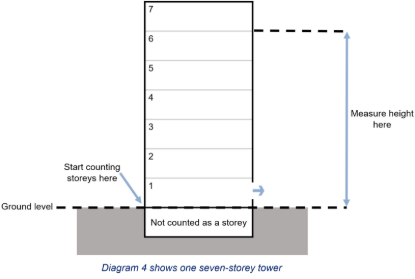
Q4: What is the current timeline of implementation for registration?
- Design & construction regime: from July 2026
- Occupation regime rollout: from 2027 onwards
- HRB registration expected: late 2027
Q5: I have had a couple of issues whereby we need to evidence building construction. The building manual is missing foundation and floor slab details. The building is showing no distress and does not warrant opening up for a condition perspective. I am waiting outcome from Home Ground as to whether they are satisfied. What is your opinion given we are duty bound to give factual information.
Q6: Is there consideration for emergency work regarding the notifications etc? as like in England.
- Structural damage
- Fire safety failures
- Dangerous services
Please note that this cannot be used to avoid the gateway application process or to avoid dealing with the relevant regulations. Often Emergency works can only be used for a small amount of work such as fitting a replacement window and not to replace all the fire doors in your HRB as an example.
Q7: Everywhere I have read has indicated that there are 66,630 building across the 3 categories. Is this an accurate number?
%20Bill%20-%20June%202026%20-%20Webinar%20Screenshot%20(7).png?width=908&height=461&name=Ventro%20Firntec%20-%20Building%20Safety%20(Wales)%20Bill%20-%20June%202026%20-%20Webinar%20Screenshot%20(7).png)
Q8: Is the application to hospitals similar to that in England in that the Act only applies during design and construction and do the building categories throw up any other variances?
Q9: Why do we feel there is such a large range of potential HRB's, and why there was so many more identified in England than expected? I always assumed this to be more regulated and precise.
Q10: As FRAs now legally have to be conducted by a competent person in Wales and as the Act has been enacted, do I need to update my FRA within 6 months of April 2026 for an in-scope building?
%20Bill%20-%20June%202026%20-%20Webinar%20Screenshot%20(5).png?width=918&height=468&name=Ventro%20Firntec%20-%20Building%20Safety%20(Wales)%20Bill%20-%20June%202026%20-%20Webinar%20Screenshot%20(5).png)
Q11: But the fitting of a temporary door - may not have the full fire resistance intended as an "official door! - will this fall under an equivalent Mandatory Occurrence Report due to potential for escape of smoke and flame?
Q12: What are the requirements for projects that are non-HRBs? Are principal contractor and designer functions still required like England?
The dutyholder regime applies to all notifiable building work, not just HRBs. Roles such as client, principal designer, and principal contractor still apply HRBs simply introduce additional controls (e.g. gateways, approvals)._____________
The introduction of the Building Safety (Wales) Act marks a significant step forward in improving the safety, management and accountability of higher-risk buildings across Wales. While the new requirements may seem complex, organisations that begin preparing now will be in a far stronger position to demonstrate compliance, manage risk effectively and protect residents.
At Ventro, we continue to work closely with building owners, housing providers, managing agents and dutyholders to help them understand evolving legislation and implement practical compliance strategies. If you have questions about the Building Safety (Wales) Bill or would like support preparing for the changes taking effect from 1 July 2026, our team is here to help.