













.png?width=397&height=365&name=CPDmember%20(1).png)
Last week the government released a new update providing additional guidance on achieving compliance with Regulation 10 of the Fire Safety (England) Regulations 2022. This guidance clarifies the responsibilities of Responsible Persons and outlines how frequently different types of fire doors should be checked. Under the regulations, all communal fire doors in buildings over 11m must be checked every three months, while flat entrance doors should be checked annually, on a best-endeavour basis. This is to ensure that fire doors remain fully functional and capable of protecting building occupants in the event of a fire.
What is Regulation 10 of the Fire safety (England) Regulations 2022
Regulation 10 focuses on the maintenance of fire doors in residential buildings. It requires responsible persons to ensure that fire doors are regularly checked and maintained to remain effective. This regulation sets out specific inspection frequencies and standards to help prevent fire spread and protect occupants, reinforcing the importance of ongoing fire door compliance in line with safety legislation.
The Importance of Fire Doors
Fire doors are one of the most important and effective passive fire protection measures in any building. They are designed to hold back smoke and flames, providing crucial time for occupants to escape and crucially, for emergency services to respond. In high-risk settings, such as multi-occupied residential buildings, their performance can mean the difference between life and death. However, fire doors can only do their job if they are properly maintained and therefore regularly inspected, making compliance with inspection schedules essential.
Why NTC's Were Introduced
Non-technical checks (NTCs) were introduced to bridge the gap between specialist inspections and routine, everyday monitoring of fire doors. Recognising that specialist inspections can be resource-intensive and less frequent, NTCs empower responsible persons, building managers and in-house teams to perform regular visual assessments. This helps catch obvious defects early, improving ongoing fire door maintenance and compliance without the need for technical surveys every time.
The Grenfell Tower inquiry highlighted the need for more consistent and practical fire door monitoring, identifying the lack of regular checks as a key area for improvement. NTCs ensure a practical, proactive approach to fire safety, reducing risks by enabling prompt reporting and action on simple but critical issues.
Can In-House Teams Complete These Checks?
The update confirms that non-technical checks can be carried out by in-house teams if they know what to look for. This means organisations can keep up with their obligations, as long as staff are equipped to spot common issues such as gaps that are too wide, damaged seals, or self closers that fail to close the door fully.
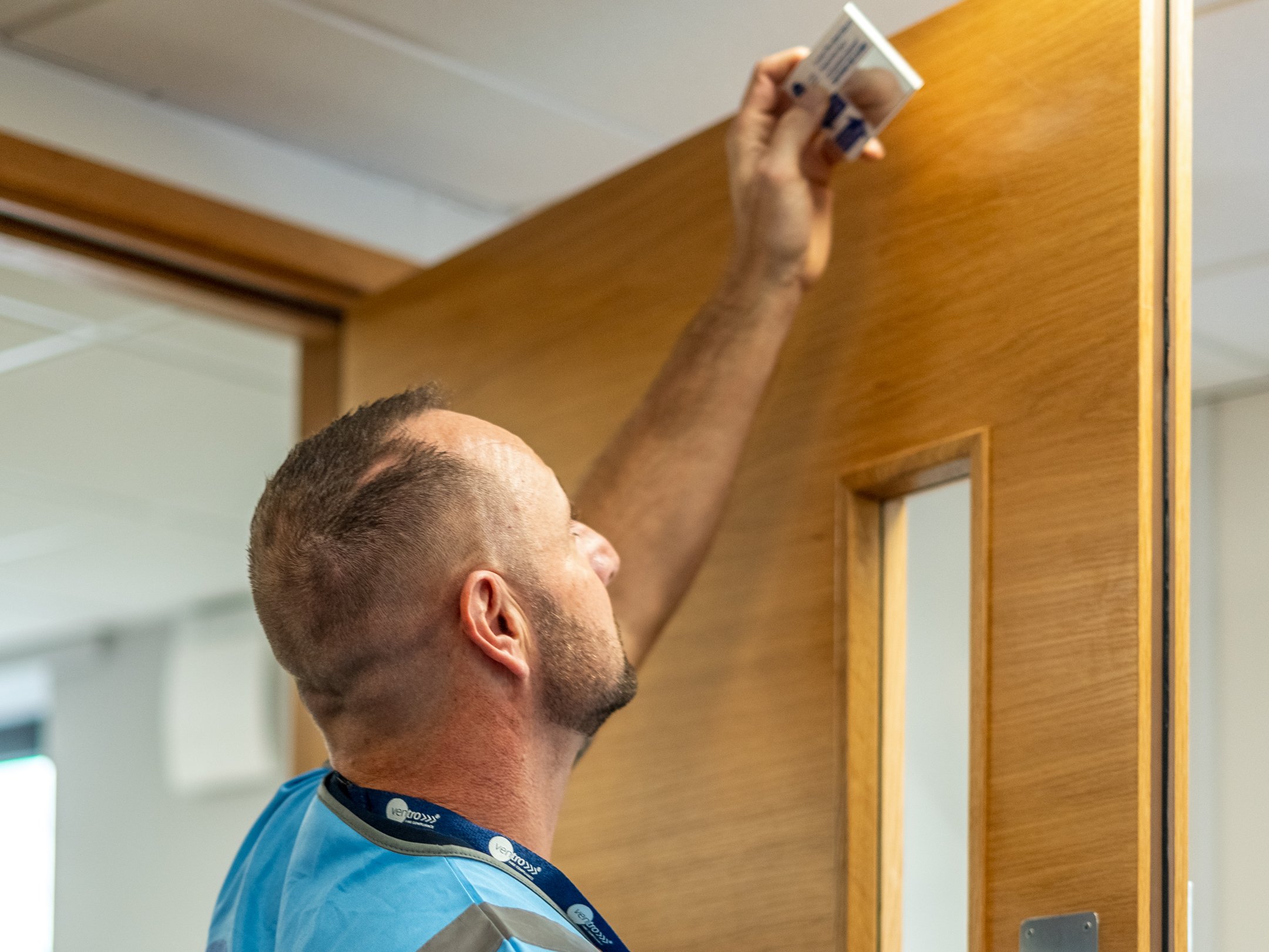
However, to ensure accuracy and consistency, targeted training should be provided to those specifically identified to carry out these checks. Clear guidance, practical demonstrations, and ongoing support can help staff feel confident in their role and reduce the risk of errors. While the guidance notes that no specialist equipment is required, simple tools such as door gap checkers can be invaluable. They not only improve the precision of assessments but also help build the confidence of team members tasked with completing NTCs across large property portfolios.
Ventro created the Non-Technical Door Checks – The Guide, which gives clear, step-by-step instructions on how to carry out a non-technical fire door checks. This free resource walks users through each stage of the process, ensuring they know exactly what to look for and how to record findings. Within the guide, users can also request complimentary door gap checkers, which we will send directly to them to support accurate and confident inspections across their property stock.
The Challenges facing NTCs
While Regulation 10 guidance highlights that non-technical checks can be completed by in-house teams, the reality is often more complex. Many housing associations manage vast property portfolios and simply do not have the resource to carry out these checks regularly. Already stretched maintenance teams face increasing workloads, and in our experience, staff without specialist fire door knowledge may feel unprepared or unwilling to take on the added responsibility of checks that carry significant safety implications.
As a result, a growing number of housing associations have outsourced NTCs to specialist providers. This ensures checks are completed consistently, competently, and in line with legal requirements, relieving in-house teams of the stress and burden of regular NTCs while maintaining high safety standards.
While the aim of NTCs is obviously not to create an additional burden for housing associations and local authorities but instead improve safety, the updated guidance does not address how these legal requirements can realistically be met without the need for external support or upscaling of internal teams. Without a clear, practical framework for resourcing and delivery, many organisations may still face significant challenges in achieving full compliance solely through in-house efforts.
Is this a step in the wrong direction?
The latest update has fuelled much debate across the industry, with some considering it a relaxation of rules introduced post-Grenfell and therefore a step in the wrong direction for fire safety. Others view the update as contradictory, arguing it conflicts with the sector’s push towards greater competency. However, some believe it was necessary, as NTCs were at times being used to pressure large landlords and housing associations into contracts. The reality is likely somewhere in the middle; while the clarification may remove unnecessary barriers for some, it does little to address the ongoing challenges of ensuring consistent, competent checks across large property portfolios, particularly without additional resources, support, or clear guidance on practical delivery. Importantly, NTCs remain a legislative requirement in order to fully comply with Regulation 10 of the Fire Safety (England) Regulations 2022.
How Ventro Can Help
Ventro can provide targeted training to give your teams the skills and confidence to perform non-technical checks accurately and safely. Our training covers the inspection process, how to identify and record defects, and when to escalate issues to specialist contractors. We also offer practical guidance on managing workloads to fit checks into existing schedules, helping ease the pressure on already stretched teams.
We also provide Non-Technical Checks – The Guide, a free step-by-step resource that walks users through exactly how to carry out an NTC. The guide includes clear instructions, visual references, and the ability to request complimentary door gap checkers, helping to build accuracy and confidence in those tasked with inspections.
In addition to training, Ventro can support by delivering outsourced NTC services where needed, providing expert surveyors who understand fire safety compliance. Whether you choose to build in-house capability or outsource, our flexible approach ensures your fire door safety checks are completed consistently, efficiently, and in full compliance with Regulation 10.