












.png?width=397&height=365&name=CPDmember%20(1).png)
Following our recent Building Safety Checklist 2026 webinar, we’ve brought together some of the questions raised by attendees along with the responses shared during the session. Many of the topics discussed are challenges currently being faced across the industry, so we hope this Q&A serves as a useful reference point for others navigating similar building safety responsibilities and compliance considerations.
Topics covered include BS 7671 Amendment 4, electrical inspection outcomes including FI classifications, medical locations, Martyn’s Law scope and tiers, and the evolving expectations around PEEPs and resident engagement. The webinar featured expert insight from Elspeth Grant from Tripple A solutions, Tamzin Robson of Foot Anstey and Josh Gisevicius from our own HJS - Part of Ventro, who shared practical guidance and industry perspectives on the legislative, regulatory and operational developments continuing to shape building safety in 2026.
Q1: Does BS7671 apply to domestic, commercial & industrial?
Yes. BS 7671 applies across all sectors, including domestic, commercial and industrial installations. It covers the full lifecycle of an electrical installation, from design and installation through to inspection and testing.
Although BS 7671 itself is not law, it is the recognised standard used to demonstrate compliance with UK electrical safety legislation and is commonly referenced within contracts, building regulations and insurance requirements.
Q2: With generators, if they already exist do they need to be upgraded to stand alone?
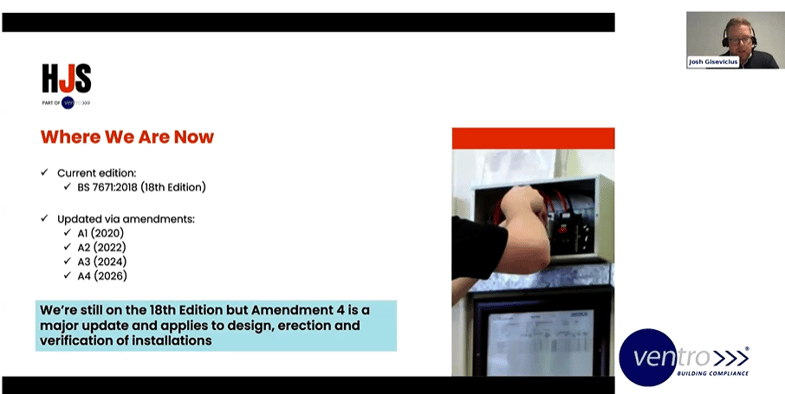
Not automatically. A key point within Amendment 4 is that new generating systems, such as solar PV or battery storage, should be installed on their own dedicated circuit in line with the updated Regulation 551.7 guidance.
For existing installations, systems are not usually required to be retrospectively upgraded purely because Amendment 4 has been published. However, where an installation is being altered, extended, redesigned, or identified as unsafe or non- compliant during inspection, the updated requirements may need to be applied to the modified part of the installation.
In practice, whether an existing generator arrangement must be separated will depend on the extent of the works being undertaken, the original compliance status of the installation, wider safety considerations, and whether the alteration triggers a redesign under the current standard.
Q3: What is FI please?
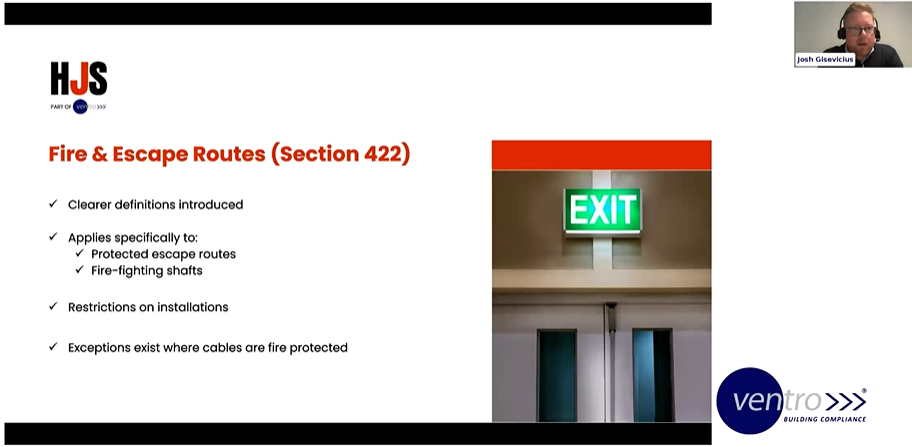
FI stands for Further Investigation. It is a classification used during an EICR (Electrical Installation Condition Report) where the inspector identifies something that may be unsafe or non compliant, but cannot confirm the severity without additional investigation.
This could relate to inaccessible equipment, uncertain earthing arrangements, suspected damage, or test results that require further examination before a definitive assessment can be made.
A key clarification introduced within Amendment 4 is that an FI classification no longer automatically makes an EICR “Unsatisfactory”. Instead, the inspector must assess whether the issue identified under FI genuinely affects the overall outcome of the report, rather than using FI as a default catch all classification.
Q4: Could you kindly share further info on medical locations and the Amendment 4 to BS7671
Amendment 4 includes updates to Section 710 covering Medical Locations. These environments have stricter electrical requirements because loss of power or electrical faults can directly affect patient safety.
The updates primarily reinforce and clarify requirements relating to continuity of supply, protection against electric shock, resilience of essential systems, and the coordination of medical electrical equipment.
Section 710 also continues to define the classification of medical locations based on patient risk and the type of procedures being carried out. Group 0 areas are locations where no applied medical equipment is used. Group 1 covers areas where equipment may be used externally or invasively, while Group 2 applies to critical care and surgical environments where a power failure could present a direct danger to life.
Additional protective measures within medical locations may include the use of Medical IT systems, supplementary equipotential bonding, enhanced fault monitoring, special socket outlet arrangements, segregation of circuits, and backup power supplies such as UPS systems or generators. These measures are intended to reduce risk and maintain the safe operation of critical medical environments.
Continuity of supply remains a key focus within Section 710. Certain medical areas are required to maintain power within strict restoration times, particularly in environments such as operating theatres, intensive care units, life support areas, and other emergency systems where interruption to power could directly affect patient safety.
The Amendment 4 updates are primarily focused on clarification, improved coordination, and alignment with newer technologies and installation practices. While the amendment does not completely rewrite Section 710, it further strengthens guidance around safe system design, resilience, and reliability within healthcare environments.
Q5: How do we define what is an "event" under Martyn's law?
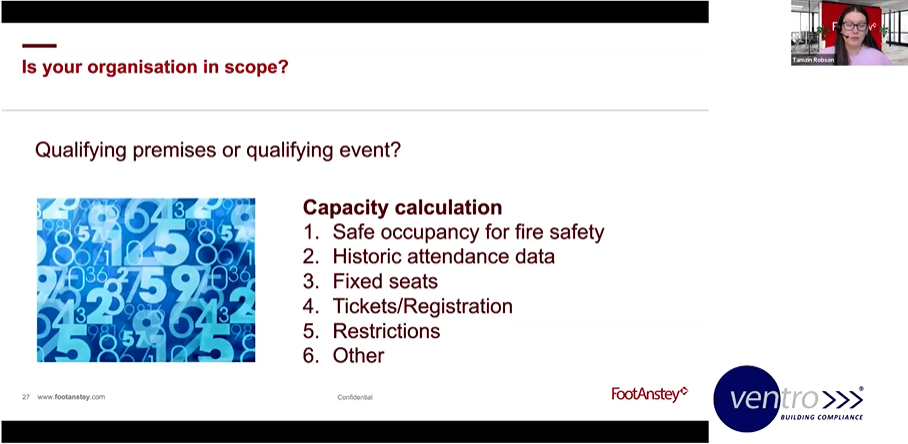
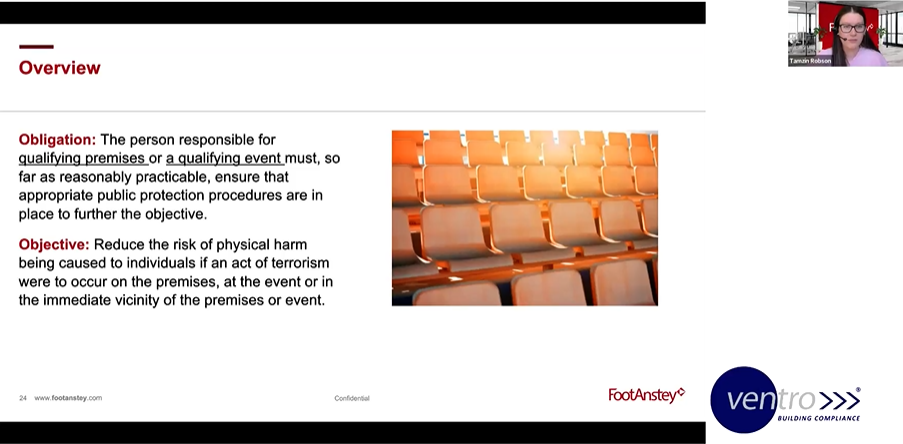
Under the Act, a “qualifying event” is not just any gathering. It must meet all of the following conditions:
It takes place:
- at a building, other land, or a building and other land, that is not already an enhanced‑tier premises
- It is open to the public
- It is reasonable to expect that 800 or more people will be present at the same time at any point during the event
- The event has measures in place to check that attendees satisfy an entry condition
- The event is not taking place at excluded premises.
Q6: Many schools and colleges already practice "run hide tell" practices, but are they now in scope for Martyn's law for their normal operational days?
Q7: What is the situation where a Work event (without Public) is being organised for over 200 people. Is this covered under the new Law? and in scope?
Q8: Which Tier will FE colleges be in?
Q9: I know the answer to this, but for the benefit of others - The BSA & Martyn's Law call in the CPR (Construction product regulations) - which is a laq. Can Tamzin confirm that any requirements in the CPR absolutely over rides any previous practice and / or other guidance documents like approved documents / British standards etc - which I understand are guidance, but not law - for context this is around the type of door furniture you use on escape routes?
Q10: Can you confirm that churches are in scope at the standard tier regardless of capacity, i.e. over 799
Q11: Are there standard temps for PEEPs that can be used to ensure all relevant and sufficient information is captured?
There are no universally mandated standard templates for PEEPs; however, Triple A Solutions has developed a comprehensive suite of templates that are issued to course participants following successful completion of relevant training. These templates are based on over seventeen years of practical delivery experience and are designed to ensure that all relevant and sufficient information is consistently captured - please refer to attachment. The templates are licensed for the personal use of the course participant.
The templates serve a dual purpose: they support the structured collation of information and provide documented evidence that all necessary considerations have been addressed.
Q12: Does this only apply in residential to tall buildings and block of flats? not individual units?
The requirements do not apply solely to tall residential buildings or blocks of flats, and the scope varies depending on the legislation:
- The Fire Safety Order: applies to the common areas of all residential buildings containing two or more dwellings where there is a shared or common space. It does not extend to individual private units themselves.
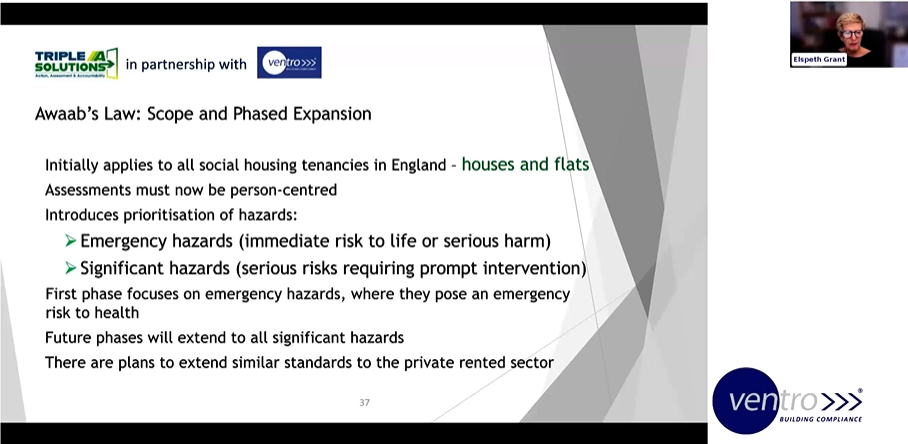
- Awaab’s Law: applies broadly to social housing tenancies, covering both houses and flats, with very limited exceptions. It addresses hazards within individual dwellings, including fire and electrical risks where these present a serious and immediate danger to occupants. Where a hazard is identified as an emergency hazard, make-safe action is required to be taken within 24 hours of the hazard being known; where this is not possible, suitable alternative accommodation must be provided.
- Residential PEEPs (Personal Emergency Evacuation Plans): are currently required for higher-risk residential buildings, specifically those over 18 metres in height or with seven or more storeys, as well as any multi-storey residential building operating a simultaneous evacuation strategy.
Q13: For private residential properties, as a managing agent if a resident refuses to pay for any measures (which I agree will very quickly be challenged under equality) - what option can a managing agent take to meet the new requirements, but ensure the safety of the resident
Under the Fire Safety Order, the Responsible Person has a legal duty to take general fire precautions to ensure the safety of relevant persons, including implementing appropriate arrangements for evacuation. Importantly, primary legislation takes precedence over secondary legislation (such as regulations) and must be complied with as the overriding legal duty.
Where a resident in a private residential setting refuses to contribute to the cost of specific measures (for example, those arising from a PEEP or similar adjustment), the managing agent still has an overriding duty to ensure safety. In these circumstances, the managing agent should:
- Undertake and document a risk assessment, clearly identifying the risk to the individual and others.
- Explore reasonable adjustments in line with equality legislation, ensuring options are proportionate and justifiable.
- Seek alternative funding routes, recognising that costs for individual adjustments are unlikely to be recoverable through standard service charges unless they demonstrably benefit all residents.
- Implement interim risk control measures to reduce risk as far as reasonably practicable (e.g. management procedures, staff support, evacuation strategies).
- Engage with the resident to explain the risk and the legal obligations, keeping a clear audit trail of communication and decisions.
- Escalate where necessary, including seeking legal advice or involving the enforcing authority (Fire and Rescue Service), particularly where there is a significant life safety risk.
Ultimately, if a required measure is essential to life safety, the Responsible Person must act to implement it regardless of cost recovery challenges. Cost disputes are a separate matter and may need to be resolved through legal routes, but they do not remove the obligation to comply with fire safety legislation and ensure the resident’s safety.
Q14: Some have short term disabilities.... is there specific time frame for them to have PEEPS?
Under the RPEEPs Regulations, there is no fixed statutory timeframe that dictates how long a person must have a disability before a PEEP is required. The requirement is risk-based, not time-based.
However, the key principle under the Fire Safety Order remains that the Responsible Person must ensure the safety of all relevant persons at all times, regardless of how long the risk exists. If a resident has a temporary or short-term disability that affects their ability to self-evacuate safely, then this must be addressed as soon as the risk is identified, regardless of how long the condition is expected to last.
To clarify, PEEPs are required wherever a person’s ability to evacuate is impaired, whether that impairment is permanent or temporary. This includes short-term conditions such as injury, illness, post-operative recovery, or pregnancy where mobility or cognition is affected. The expectation is that:
- A risk assessment is updated immediately once the change in circumstances is known.
- Appropriate measures (including a PEEP or interim arrangements) are put in place without delay.
- The arrangements are proportionate to the level and duration of risk, meaning short-term issues may be managed through temporary or simplified plans.
- The situation is reviewed regularly, with the PEEP removed or amended once the individual’s condition improves.
In the context of social housing, Awaab’s Law places clear expectations on landlords to act promptly where a hazard presents a serious and immediate risk to health or safety. Where such a risk is identified, make-safe action must be taken within 24 hours to make the situation safe, or suitable alternative accommodation provided if this cannot be achieved. This reinforces the need to respond immediately to changes in a resident’s circumstances, even where the condition is temporary.

Q15: As an LA we find that residents are content to share personal info with us. Yet they are not willing for certain details to be on paper within a SIB. Some LFB templates shared seem to ask for a level of info which is reasonably explicit. Creates a dilemma.
This situation reflects the need to balance fire safety duties with data protection, emergency response needs, and safeguarding considerations. While residents may be willing to share personal information verbally, they can be reluctant to have sensitive details formally recorded, particularly within a Secure Information Box (SIB) that may be accessed in an emergency.
Under the Fire Safety Order, the Responsible Person must ensure that relevant information is available to support safe evacuation. However, this does not require excessive or intrusive personal detail—only information that is necessary and proportionate to manage the risk.
The Data (Use and Access) Act 2025 strengthens this position by introducing recognised legitimate interests, providing greater clarity and confidence for organisations to process and share personal data without consent where it is necessary for emergency response, safeguarding, and the protection of life.
In practical terms, this means that where information is required to support fire safety measures, evacuation planning, or to inform emergency services, it can be lawfully processed and shared without explicit resident consent, provided it is necessary, proportionate, and directly linked to managing risk. This is particularly relevant where failure to share information could place a resident or others at serious risk of harm.
In this context, the use of resident information to support fire safety and evacuation planning aligns clearly with these recognised legitimate interests, reinforcing that life safety and safeguarding considerations can take precedence over consent, provided data is handled appropriately and securely. See: https://www.gov.uk/guidance/data-use-and-access-act-2025-data-protection-and-privacy-changes#:~:text=Recognised%20Legitimate%20Interests,and%20other%20specified%20legitimate%20interests.
The latest edition of the Code of Practice for the Provision of Premises Information Boxes in Residential Buildings, published by the Fire Industry Association (FIA) in collaboration with the National Fire Chiefs Council (NFCC), reinforces this position. It emphasises that information held should be relevant, risk-based and proportionate, and that Responsible Persons should avoid including unnecessary personal or sensitive data. The guidance supports the principle of data minimisation, ensuring that only information that would assist operational response and firefighter decision-making is included. See: https://www.fia.uk.com/news/updated-secure-information-boxes-sib-s-code-of-practice-released-to-strengthen-building-safety-and-emergency-response.html
It is also important that any information placed within a SIB is appropriately controlled and, where possible, coded or anonymised, so that it does not clearly identify the location of all vulnerable residents if the box were accessed by unauthorised persons. This supports both data protection and safeguarding principles.
In practice, this means:
- Only recording the minimum information required to support safe evacuation (e.g. mobility impairment, need for assistance, presence of oxygen), rather than detailed medical histories.
- Avoiding unnecessary sensitive detail where it does not directly impact evacuation or fire risk.
- Using coding, symbols, or reference systems rather than explicit identifiers wherever possible.
- Clearly defining who can access the information and ensuring it is restricted to those involved in emergency response.
- Being clear that information may be shared with emergency services where necessary to protect life, even without explicit consent.
- Using clear, resident-friendly explanations about why the information is needed, how it will be used, and who may access it.
- Seeking informed consent where possible, and documenting where consent is declined.
- Considering alternative approaches where residents refuse written records, such as coded or summarised information, or management-based evacuation arrangements.
- Ensuring compliance with data protection principles, particularly data minimisation, purpose limitation, security, and safeguarding of vulnerable individuals.
It is also important to note that templates (including those from fire authorities such as LFB) are often designed to be comprehensive, but they are not prescriptive legal requirements and should be applied proportionately.
Ultimately, the priority is ensuring that, in an emergency, responders have sufficient information to act safely and effectively, while respecting individuals’ privacy and maintaining robust data handling and safeguarding standards.
_____________
We’d like to extend a sincere thank you to our speakers, Elspeth Grant, Tamzin Robson and Josh Gisevicius, for sharing their insight throughout the webinar, as well as everybody who attended and contributed questions during the session. Many of the discussions raised reflect the wider challenges currently being faced across the industry, and the level of engagement helped make the webinar both practical and informative.
If you found this Q&A useful, be sure to sign up for updates on future webinars and events from Ventro Group. As legislation, guidance and best practice continue to evolve, our events are designed to help building safety professionals stay informed and prepared for the changing compliance landscape.